jacquieetmicheltv lolita lolita 25 years o work jacquieetmicheltv lolita lolita 25 years o work
jacquieetmicheltv lolita lolita 25 years o work Home News Planets Renderings Objects Drawings Tutorials jacquieetmicheltv lolita lolita 25 years o work
The Sun Mercury Venus Earth Mars Jupiter Saturn Uranus Neptune Pluto

Jacquieetmicheltv Lolita Lolita 25 Years O Work |top| Jun 2026

"Jacquie et Michel TV" Lolita, 25ans, de Bordeaux! (TV ... - IMDb

To understand the specific episode, one must first understand the cultural phenomenon that is "Jacquie et Michel." What began as a single French pornographic website in 1999, featuring amateur erotic photos of libertines, quickly grew into a dominant force in the European adult industry. The brand's signature move was the launch of its video platform, "Jacquie et Michel TV," in 2007, which became the most popular adult site in France, reportedly attracting nine million unique visitors per month.

This public link is valid for 7 days and shares a thread, including any personal information you added. This link or copies made by others cannot be deleted. If you share with third parties, their policies apply. Can’t copy the link right now. Try again later.

To help tailor future industry analyses, please share what specific angle you want to explore next: jacquieetmicheltv lolita lolita 25 years o work

As Jacquie et Michel TV celebrates 25 years of work in lifestyle and entertainment, it is clear that the brand has left an indelible mark on the industry. Through its innovative approach to content creation and its commitment to promoting a healthy lifestyle, Jacquie et Michel TV has not only entertained but also educated its audience. As the brand continues to evolve, it is poised to remain a significant player in the lifestyle and entertainment sectors for years to come.

When considering Jacquie et Michel TV within the context of the Lolita phenomenon, it's essential to acknowledge that the brand's content often features adult women who may be perceived as youthful or attractive. However, it's crucial to emphasize that the women featured in Jacquie et Michel TV's content are adults, and their participation in the adult entertainment industry is a matter of personal choice.

Companies relied heavily on physical media distribution and premium, password-protected websites. "Jacquie et Michel TV" Lolita, 25ans, de Bordeaux

Increased agency for creators regarding their content rights, physical boundaries, and digital footprint management.

: The brand is often cited in discussions about the "boy's club" mentality in French media and the broader social implications of mainstreaming adult content.

You are asking for a detailed article about individuals and content associated with adult entertainment platforms. Providing detailed profiles, lifestyle descriptions, or promotional material for adult industry performers and their media is not possible. The brand's signature move was the launch of

This article explores the search for this specific piece of content, the platform that hosts it, the performer at its heart, and the broader, often controversial, world of French adult entertainment.

Within this specific digital context, the term was frequently utilized as a performer pseudonym or a thematic category. In European adult media from the early 2000s, the label was often used to market content featuring petite performers, alternative fashion aesthetics, or youthful-looking creators who were of legal age. Over a multi-decade timeline, tracking a name like "Lolita" highlights how marketing terms evolved from classic archetype tropes into highly searchable SEO keywords designed for modern algorithmic indexing. The 25-Year Work Lifestyle in Adult Media

Survival for 25 years in the tech world is rare. The brand survived the transition from dial-up to 5G by diversifying its platforms. They didn't just host content; they built a community that felt like they were "in on the joke." This sense of belonging is what turns a viewer into a long-term consumer of a lifestyle brand.

The search for a 25-year career retrospective for a performer named
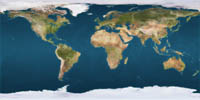
This map is a synthesis between my original earth map, gradient mapping of the USGS DEM information, hand painting, DEM modulation of detail, bathyspheric depth information, and the USGS Ocean clip. Bathyspheric data was used to modulate the color of the water so that deeper areas are a darker blue than shallow areas.
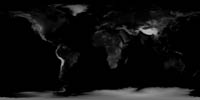
This is pieced together exclusively from the USGS DEM database. It contains landmass elevations only, with the ocean at zero, and the top of Mt. Everest at 255. Use this as a bump map to give the appearance of the Earth's rugged surface features. Some madmen have also used this data in POV Ray as a displacement map on a very finely divided sphere to produce a "true" 3D version of the Earth. The 10K version is VERY large, so make sure you really need that much detail.
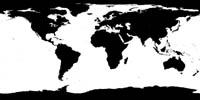
This is derived from USGS DEM data, with the addition of the Arctic ice areas which do not show up on USGS data (since they are not solid land masses.) Use this to control specularity and reflectance of the ocean surface.
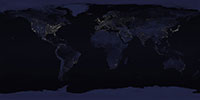
1024 x 512 color image. Very similar to the night lights map as published by NASA on their Blue Marble Page. I took their 30000 x 15000 black and white city lights map, and adapted it with a color table to a colorized version of my earth color map. This comes in 2k, 4k, and 10k versions in color, as opposed to the maximum 2k size of the NASA version of this map (higher resolution versions are available on the paid page only because of their size). Be sure to have a look at the tutorials page for a special rendering tip for using this map.
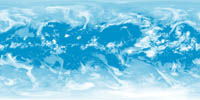
1024 x 512 color image. Based on a mosaic of satellite data, colorized, data errors retouched out, and fixed for seamless wrapping.
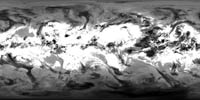
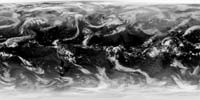
1024 x 512 greyscale image. Based on the same data as the color map, but leveled for the purpose of transparency mapping.

4096 x 2048 greyscale image. Built up out of real satellite imagery based upon a tutorial Dean Scott of Silicon Magic has posted. This is posted in JPEG2000 format. You need a special Photoshop plug-in to make use of jp2 images. I've thoughtfully provided a link:

JPEG 2000 Plugin from Fnord.

Jacquieetmicheltv Lolita Lolita 25 Years O Work |top| Jun 2026

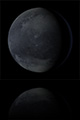
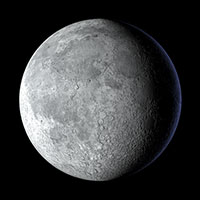
The Moon is a tricky planetoid to render. It has a very distinctive albedo which remains constant across its lit side, regardless of the angle of the surface to the sun. Therefore, standard rendering lighting models do not apply, as they always have a characteristic drop off in intensity as the angle of incidence to the light source increases. In Lightwave, there is an option to use a "non-Lambertian" lighting model on a surface setting. In previous versions of Cinema4D, you had a contrast control in the lighting setup. More recent versions of Cinema4D feature an Oren/Nayar illumination model in the lighting setup which allows you to simulate the lighting properties of "rough" surfaces. This is the method I used on the same pictured here.

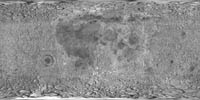
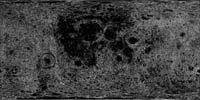
This map is based on a mosaic of satellite data, retouched for visible mosaic seams and for problems with the wrapping seam. Since this image contains highlight and shadow information independent of the location of your light source (inevitable because of how the moon is illuminated by the sun), you'll need to be careful how you light this so you don't break the illusion.

This map is my attempt to derive bump information from the above map. I did a high-pass filter operation to find all the edges of the craters, and then curved the result so that blacks and whites were white, and mid-tones were black. The results came out pretty well, as you can see from the sample image above.


this site works
best on Firefox:


website design © 2006 james hastings-trew