Basics


Info Download

Advanced

v/v
V
V

Plot Download

The official 5th Multi Colour Edition is available for purchase on . The price is typically much lower than the physical paperback, and you can read it instantly on your smartphone, tablet, or laptop using the free Kindle app.

Use the Malik & Arora book as a rigorous, practice-oriented textbook: focus on doing many exercises, reproducing proofs, and summarizing theorems and hypotheses. That approach will maximize both conceptual understanding and problem-solving ability in real analysis.

Are you preparing for a or a competitive exam like CSIR-NET/GATE?

Kline took the book with the proprietary air of a man who had once directed dissertations and therefore owned their afterlives. He flipped the pages, read a few lines and made a sound that was neither laughter nor scoff, but a recognition.

Word spread beyond the department. A visiting scholar from another university arrived with his own copy of Malik & Arora and compared margins like convicts comparing tattoos. He brought a story of Savita Arora lecturing in a small auditorium years ago and collapsing the complexity of a proof into a single diagram that had lit the room. S.C. Malik was remembered as remote and rigorous, prone to coaxing young researchers to “feel the curve” rather than chase formalism.

The proofs are written with meticulous detail. Unlike advanced texts that leave steps "as an exercise for the reader," this book guides students through the logical progression of complex proofs.

: If you're unable to afford a textbook, explore alternatives like:

: The clear presentation of proofs helps candidates write structured answers in written examinations. Accessing the Book: Legal and Digital Considerations

"Mathematical Analysis" is a comprehensive textbook that covers the theoretical underpinnings of calculus and real analysis. First published in the early 1990s, the book has since been revised and updated, with the latest released in 2017. It is designed to bridge the gap between elementary calculus and more advanced, proof-based mathematical thinking.
Disclaimer: This tool is provided for educational and illustrative purposes only. No guarantee is made regarding accuracy, suitability, or performance. Use at your own risk. - Copyright: ufelectronics.eu / Andreas Dyhrberg

×
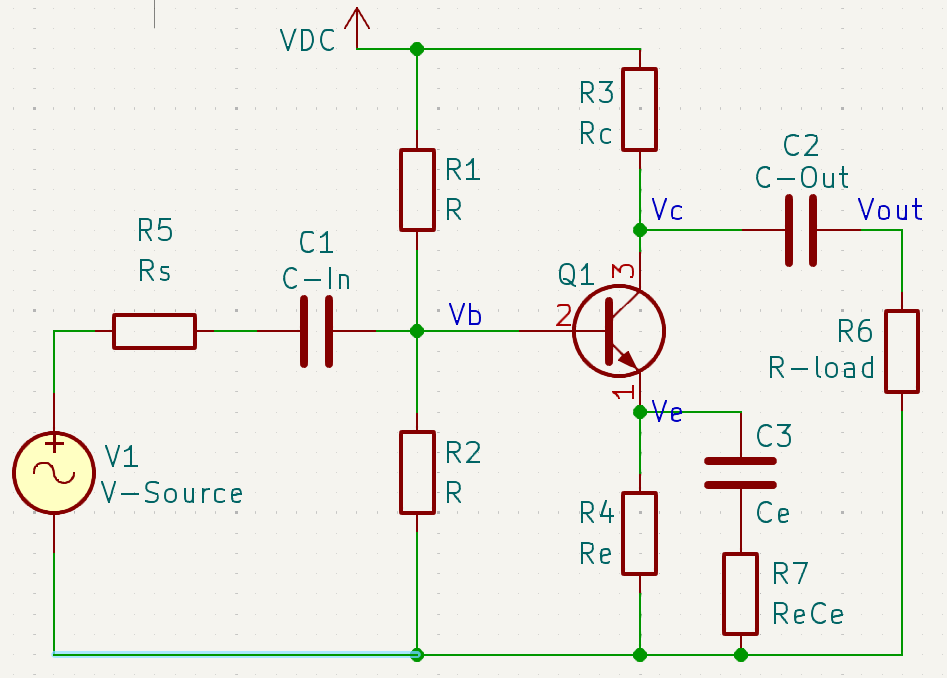
Amplifier Schematic
×

There are different ways to calculate an amplifier, depending on what you want to achieve.

Maybe you want to achieve a certain gain, as far as possible (classic mode). Or you have a low Vcc to respect (modern mode). Or you work with analog audio amps (symmetry mode).

Depending on what you want to achieve and the way of calculating it. Some fields might become dependent on others, or the other way around.

Your above choise makes some input fields available for manipulation, while hiding others.


🎯 1. Target Gain (Av) — "Classic mode" The official 5th Multi Colour Edition is available

You care about how much your amplifier multiplies the input signal.

Set desired voltage gain and Rc voltage drop. Best for learning and simple amplifiers.

You say: “I want a gain of 10.”
The app adjusts resistors to try and match that.
You must give Av and Vrc (the voltage dropped across Rc).

Best for common emitter amplifiers.

✅ Default choice for most beginners and educational use. He flipped the pages, read a few lines


⚡ 2. Target Emitter Voltage (Ve) — "Modern mode"

You care about setting a healthy DC bias point.

Prioritize stable biasing via Ve. Useful for low-voltage circuits or precision designs.

You say: “I want Ve = 0.5 V, to keep the transistor out of trouble.”
This makes sure your transistor stays in active mode.
Gain becomes whatever it turns out to be.

Ideal for common emitter amplifiers when the goal is to ensure proper biasing for low-voltage or precision circuits, and it’s also used in class AB amplifiers to prevent distortion proof-based mathematical thinking.

✅ Useful in low-voltage designs (e.g., 3.3V systems).


🧭 3. Target Collector Voltage (Vc) — "Symmetry mode"

You want to place the collector in the middle of the power rail.

Target Vc = Vcc/2 for maximum signal swing. Great for audio and analog signals.

You say: “Make Vc = Vcc/2” for maximum swing.
Useful for analog audio amps or symmetrical headroom.
Gain and Ve are outcomes.

Best for common collector amplifiers and class AB amplifiers.

✅ Best for signal integrity.

Savita Arora Pdf Free Exclusive Repack — Mathematical Analysis By Sc Malik And

The official 5th Multi Colour Edition is available for purchase on . The price is typically much lower than the physical paperback, and you can read it instantly on your smartphone, tablet, or laptop using the free Kindle app.

Use the Malik & Arora book as a rigorous, practice-oriented textbook: focus on doing many exercises, reproducing proofs, and summarizing theorems and hypotheses. That approach will maximize both conceptual understanding and problem-solving ability in real analysis.

Are you preparing for a or a competitive exam like CSIR-NET/GATE?

Kline took the book with the proprietary air of a man who had once directed dissertations and therefore owned their afterlives. He flipped the pages, read a few lines and made a sound that was neither laughter nor scoff, but a recognition.

Word spread beyond the department. A visiting scholar from another university arrived with his own copy of Malik & Arora and compared margins like convicts comparing tattoos. He brought a story of Savita Arora lecturing in a small auditorium years ago and collapsing the complexity of a proof into a single diagram that had lit the room. S.C. Malik was remembered as remote and rigorous, prone to coaxing young researchers to “feel the curve” rather than chase formalism.

The proofs are written with meticulous detail. Unlike advanced texts that leave steps "as an exercise for the reader," this book guides students through the logical progression of complex proofs.

: If you're unable to afford a textbook, explore alternatives like:

: The clear presentation of proofs helps candidates write structured answers in written examinations. Accessing the Book: Legal and Digital Considerations

"Mathematical Analysis" is a comprehensive textbook that covers the theoretical underpinnings of calculus and real analysis. First published in the early 1990s, the book has since been revised and updated, with the latest released in 2017. It is designed to bridge the gap between elementary calculus and more advanced, proof-based mathematical thinking.